Peak and valley hours, written by you
See the expensive hours before you spend them
Type the times that cost more. PeakLess draws one band per rule and says what is cheap now, when it flips, and which start is cheapest for a job that has to finish by a given time.
PeakLess does not connect to any service and does not fetch a live price: you copy the hours from your bill or the vendor page, and every calculation runs on the device.
- Runs offline
- No account, no sign-up
- Your own timezone, overnight windows included
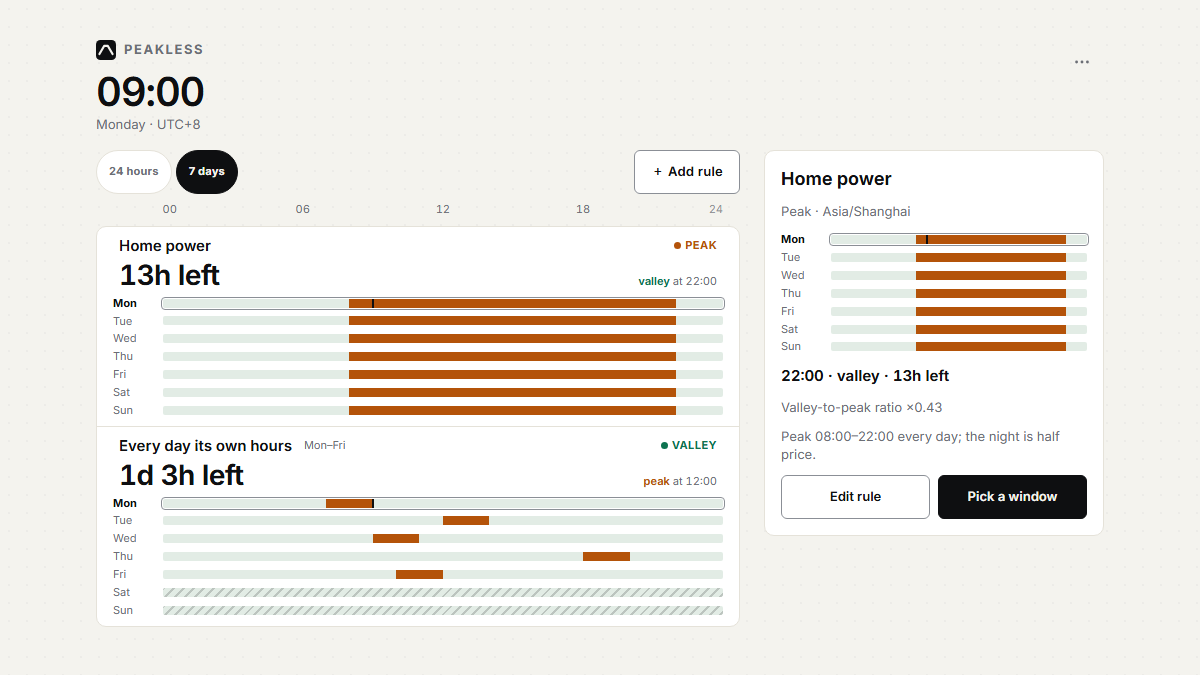
Real screens from the current build: Monday 09:00 in Shanghai, the peak has 13 hours left, and the second rule only runs on weekdays.
One tariff day, midnight to midnight: peak 08:00–22:00 in amber, everything else valley.
How it works
Three steps, in the order people actually need them.
-
Write the hours
A power tariff, an API that charges more at peak, a metro rush hour. You type the hours yourself, in the zone they use.
-
Read the band
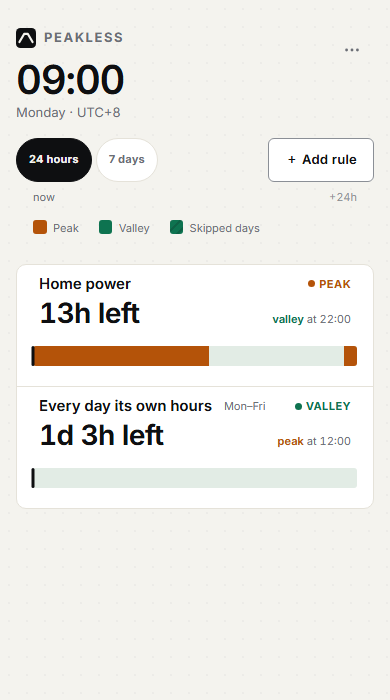
Peak in amber, valley in paper, the present pinned to the left edge, and the wait to the next switch in plain words.
-
Ask the planner
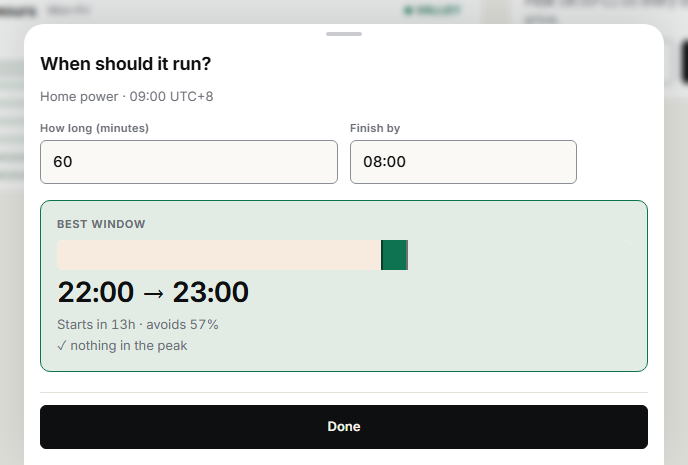
Give a duration and a deadline. It returns the cheapest start, the cost of running it there, and what waiting saves.
What is inside
No setup, no dashboard. Rules, bands, and one question: when should it run?
-
Days per window
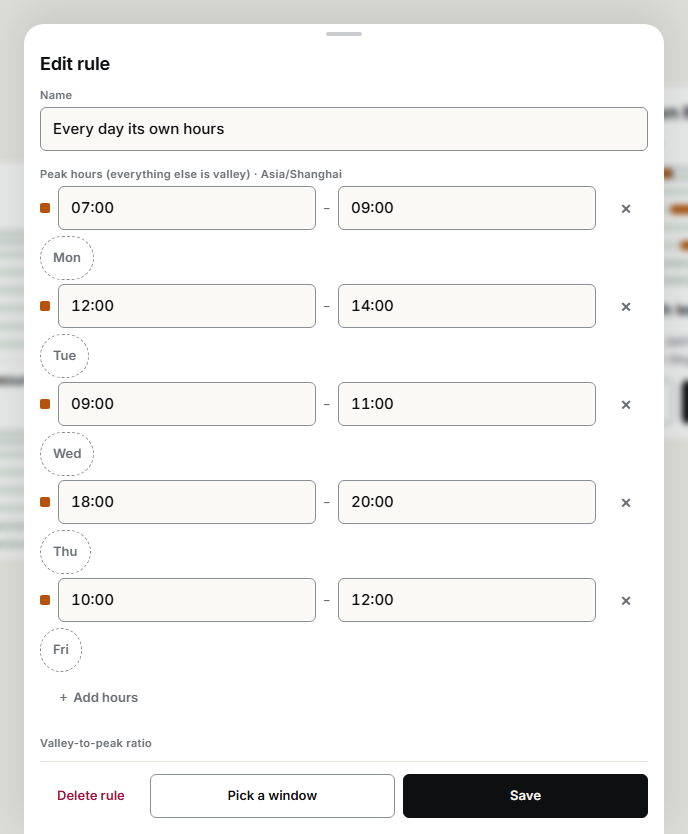
Monday 07:00–09:00, Saturday 10:00–12:00 — one rule, different days.
-
The countdown
How long until the band flips, on the clock you are looking at.
-
The planner
Duration in, deadline in, cheapest start out — with the spill shown, not hidden.
-
Reminders
A nudge before a cheap window opens, from the device that holds the rule.
-
Share a pack
Your rules travel as one link; the reader's device keeps them.
-
Your rules stay on the device
Rules are stored where you wrote them. No account, no sync, nothing to configure.
See it
Three more screens of the app as it is now, in the language you are reading.
Questions people ask before trying it
- When is it out?
- The app is built and the store listing is the last step.
- Does it read a price feed or connect to anything?
- No. There is no data source behind the bands: you copy the hours from your bill or the vendor page, and the maths runs on the device.
- Does it need internet?
- No. Rules are read and computed on the device. Turning off the network changes nothing about the bands.
- Which timezones work?
- Any IANA zone. Windows are written in the rule's own zone, the band is cut at local midnight, and an overnight window covers its tail into the next morning.
- Can a rule really change by day?
- Yes. Every window carries its own list of days, so the same rule can have a commute peak on Monday and a different one on Saturday.
- Who can see my rules?
- Only your device. There is no account to log into and nothing to sync.
Get it when it ships
The rules you write today are the rules it runs on day one: a tariff, a delivery cut-off, a metro rush hour.